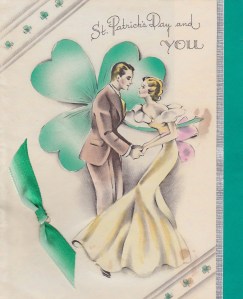
St. Patrick’s Day

Card from my grandpa to my grandma, 1950s (Private family collection)

Ah…spring is in the air. The sunshine and rising temperatures have melted a recent 10″ snowfall here in St. Paul, daylight saving time is on, and St. Patrick’s Day is just around the corner. I love this time of the year. I can’t wait to catch a few performances by Rince na Chroi (the Irish dance group my nieces perform with) this weekend and enjoy a pint or two of Guinness to celebrate my Irish American heritage.

When I was a kid in Minneapolis during the 1970s and 1980s, no one I knew made a big deal about St. Patrick’s Day. We were an Irish American family and proud of our roots, but the most we did on the day was walk up to Curran’s Family Restaurant for the corned beef and cabbage dinner. The meal’s highlight for me was a small dish of vanilla ice cream drizzled with a bright green creme de menthe sauce for dessert.
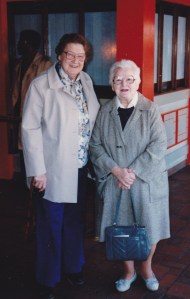
Grandma is on the right – I think this is in Vegas, not Curran’s! (Private family collection)

As I think about those times, I can see my Grandma in her spring coat, a shamrock formed from fuzzy, green pipe cleaners pinned to her shoulder. She had a white scarf printed with delicate green shamrocks tucked around her neck under the coat’s collar like older women used to wear. Grandma stood patiently in the packed restaurant, handbag dangling before her, smiling pleasantly as we waited far too long for a table to open up.

I imagine that Grandma wondered why so many people were at Curran’s making such a fuss about St. Patrick’s Day. It was so different from when she was young.

My grandma was not just a wonderful person and grandma; she was my physical link to my family history. As a girl, she spent time with her grandpa, who came from County Fermanagh in the mid-19th century. She shared the stories she remembered from him and stories of her other Irish grandparents. My grandma’s stories fed my curiosity about my family’s origins. Grandma embodied all of that for me.

This time of year, I hear people in Ireland scoffing at the American tradition of corned beef and cabbage on St. Patrick’s Day (“No one EVER eats that in Ireland,” they say). Point taken, but meat, cabbage, potatoes, and carrots are certainly consumed in Ireland today as they were one hundred years ago and more when most of the ancestors of the nearly 32 million Americans who claim Irish ancestry came to America. That was a time when corned beef was widely available and affordable. As immigrants established themselves in their new homes, new food sources became available, and corned beef seemed to be phased out.*

I consider my grandma’s boiled dinner the quintessential Irish American meal. How her house smelled while it was cooking, how she served it up with the same spoon her mother used, and the cursory, “You’ll have another potato,” as a statement rather than a question made it feel like generations of family memories simmered in that pot. This is the food they ate on the farms in Clontarf, Minnesota. Cooking was another way Grandma told family stories.

Grandma’s humble boiled dinner will not replace today’s delicious St. Patrick’s Day fare, but it remains an expression of my family’s history. Compared to my St. Patrick’s Day experiences (and Grandma’s before me), the day has become an overly-hyped commercial event. That said, seeing how excited my nieces get for St. Patrick’s Day is fun. They perform all over the Twin Cities, march in the parade, hang out with their friends, and generally have a ball. Times change. Whether you celebrate your heritage, the contributions of the tens of millions of Irish Americans, or just like to have fun, St. Patrick’s is the day for you.

Grandma’s Boiled Dinner Recipe

Put enough meat (seasoned with salt and pepper), potatoes, carrots, cabbage, and onions to feed however many people you have for dinner in a pan with water, boil, and simmer until the meat is tender and the vegetables are done.

Grandma used country-style pork ribs (I only know this from shopping with her). I regret that I never noticed how Grandma put together the boiled dinner. It was usually ready when I got there for dinner, and it was always delicious. Mine has never tasted as good as Grandma’s, but I’ll work on it.
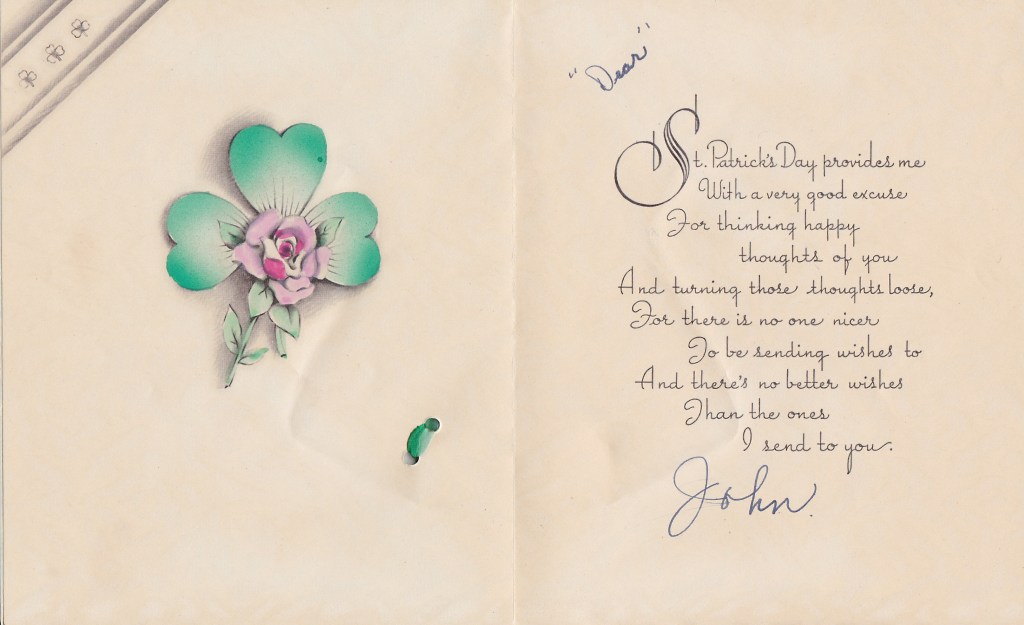
Interior of card from my grandpa to my grandma, 1950s (Private family collection)

*I didn’t get into the whole story here, so if you are interested in the history of corned beef in Ireland, read this article. It is fascinating.
Can I Quote You on That?

I came across this the other day…

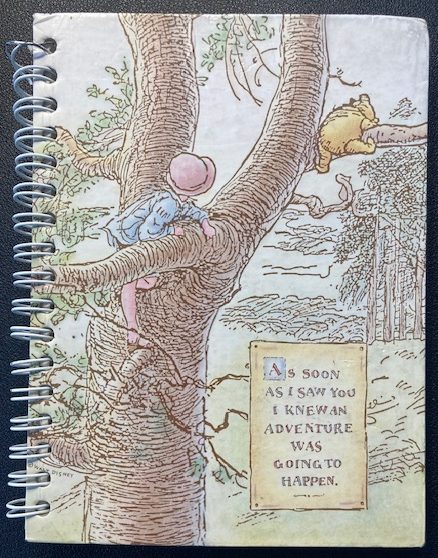
Winnie the Pooh notebook – 5″x7″

My sister gave me this little notebook in August 1990 (she dated it on the first page – Regan is an archivist’s dream…she dates everything!) I bet she bought it in a cute Georgetown stationery store or one of the museum shops. After graduating from Smith College in May 19090, Regan moved to Washington, D.C. She worked at a law firm and lived in a cute studio apartment on Wisconsin Avenue, across the street from the National Cathedral. Everything she could want was within a few blocks: Giant Foods, a pharmacy, and the Zebra Room with 2-for-1 pizzas on Tuesdays. Regan went to museums on the weekends, ate noodles in Dupont Circle, and took the metro around town. When I visited in August, she was still settling in and did not seem thrilled with her situation, but I thought she had it made. I was due at Colby College in Waterville, Maine, later in the month to start my freshman year. Instead of participating in the highly recommended, but not required, Colby Outdoor Orientation Trip (COOT), I opted for a week in D.C. with my sister.

It is a complicated business, being the younger sister to a first-born daughter (I know, I know…it’s all complicated). I have always looked up to Regan and wanted to be doing whatever she was doing. And I wanted to do it together. When I was small, I wanted to be her friend. That was never going to happen. I was a disruption, nothing but an annoyance. As I grew up, I still craved Regan’s attention, but I made my own friends, and to avoid comparisons to Regan (who was perfect in my book), I started forging my own path. The dynamic began to shift when Regan went to college. Apparently, I was less annoying in the smaller doses of school breaks.

Back to August 1990 and the notebook. Regan wrote a lovely message on the first page. She thought the book would be perfect for collecting quotes and advised me to enjoy every minute of college and learn all I could. Regan is so good with inspirational messages; she gets that from our dad, a former coach and teacher (as well as from those “Believe in yourself and work hard as you chase your dreams…” motivational posters illustrated with either a rainbow or a sunset from the 1970s). I filled the book with my favorite quotes. Over the years, the little book disappeared into the abyss of the desk drawer. When I discovered it, I noticed I only wrote on one side of each page, so I am collecting quotes again thirty-five years later. And Regan’s advice to learn all I can is as relevant today.

Speaking of quotes…

During the COVID-19 pandemic, I found a site selling beautiful notecards made of handmade Italian paper with letterpress-printed quotations. There was a card with the Emily Dickinson quote, “Hope is a thing with feathers that perches in the soul, And sings the tune without the words, And never stops at all.” The perfect message to send to loved ones feeling trapped by lockdowns and isolated by social distancing.

Bridget makes the gorgeous cards at Occasionally Speaking. She chooses quotes that are perfect for specific occasions (e.g., anniversaries, birthdays, graduation, etc.) and when you want to drop a line to a friend just because.

Quote of the Day

I was really into Kandinsky in 1990. This was the first quote I recorded in the Pooh notebook:

That is beautiful which is produced by the inner need, which springs from the soul.

Wassily Kandinsky (1866-1944) Russian painter

I

History Through Fiction

Earlier this month I participated in a three-session workshop presented by Colin Mustful, the founder of History Through Fiction, an independent publisher of historical fiction. Colin is based just up the road from me in Roseville, MN, and is a talented historical fiction author. He is passionate about storytelling, growing the field of historical fiction, and promoting new and established writers.

I was surprised during the introductions at the start of the first session by the number of attendees who had already written and published historical novels. Since I had never written a novel of any kind, I thought I might be in a little over my head. I was wrong. It was a fantastic group of writers, looking to work on their craft and learn from other writers. Colin provided an in-depth exploration of what historical fiction is and how to get started writing it. Colin said he is planning to add more classes and workshops to the History Through Fiction repertoire. He already hosts a regular panel series, “What’s New in Historical Fiction” offered on Zoom. The panels typically consist of four published historical fiction authors sharing their motivations and experiences. There is a discussion coming up Monday, February 27th – Click here for more information!

One of our assignments was to take a primary source and create a scene around it. I chose a letter my sister had transcribed a number of years ago from our Great Aunt Mary to her sister, Agnes. Agnes was our grandma. My grandma hung on to just a few old letters, so this must have held special significance. Mary included her recipe for spritz cookies in the letter, which I think explains the significance and why Grandma held on to it.

I created a fictional scene around the letter, featuring my mom and my grandma. It was fun to write. I caught a glimpse of what I might want to do with all of the family memories, stories, and histories I hold so close to my heart. Using fiction to fill in the gaps of what I don’t know was liberating. It is OK that every detail is not a known fact or exactly perfect.

Cold Snap with Love

“Is that you, Eileen? Shut that door and come inside! No need to heat the entire neighborhood.” Mom scurries to the front door from the kitchen.

Eileen wins the battle with the blizzard-strength wind and pushes the door closed. She is tall for a fourth-grade girl and slim, but strong.  

“The afternoon mail is here and there’s a letter from Aunt Mary! Can we read it?” Eileen hands the letter to Mom and takes off her mittens. She reaches behind her head to untie the bulky knit scarf, but the knot is too tight. Sister Barbara was a bit overzealous with the scarf-tying assistance. She worried that her students would freeze as they walked home from school that frigid afternoon. Eileen was so tightly bundled up that she could barely move her head from side to side to check for cars when she crossed Chicago Avenue. 

“How on earth did you accomplish this, I wonder?” Mom undoes the knot and unwinds the web of knitted wool. “This looks like Sister Barbara’s work.” Mom takes Eileen’s jacket and snow pants and helps her off with her boots.

Mom wraps her arms around Eileen and warms her up with a big squeeze. Mom’s apron smells like baking – nutmeg, cloves, and ginger. Eileen wagers with herself that it is a spice cake. She can almost taste the dense cake, dark brown from molasses, full of nuts and raisins, with shimmering sugar sprinkled on top. 

“The kettle is on. Let’s see what news your auntie has for us.” Mom walks out to the kitchen, waving the letter behind her.

“Sit yourself down. You can start reading while I get the tea.” Mom places the letter on the table.

Mary is Mom’s oldest sister. She lives in Benson. That’s near where Mom was born, but when she was eleven, she moved to Minneapolis with her family. Mary stayed in Benson to work and help their Aunt Maggie. Eileen loved letters from Mary because Mom loved letters from Mary. The sisters were the best of pals.

Eileen slides her finger under the flap and opens the envelope. Two pieces of plain white writing paper are carefully folded in half inside. 

“It’s two pages! Should I start reading?” Mom nods. Eileen clears her throat and sits up straight.

Mary calls Mom, “Agg.” Her name is Agnes. Mary has nice cursive and only misspells a few words, here and there. Eileen begins:

Wenesday evening. Dear Agg, John and kidds, got your letter today and was glad to hear from you and that you are all fine. As this leaves us the weather here has been very cold all day. Quite a change. It was 28 below this AM. Sure burns up the fuel oil…”

Mom interrupts with a chuckle, “Wasn’t it good of Mary to send the cold with her letter!”

Eileen smiled and continues:

Suppose you are bingoing this evening. Hope you win. So you and Margaret are doing your Christmas baking together. That sure is nice. I sure miss you. I made fruit cake too…it was good. We had some for supper. I have made some cookies and candy. Wish you were here and would make coffee and munch. Ha ha!

Mom sets down the tea and two slices of fresh spice cake on the light gray Formica kitchen table. Eileen beams at the sight of the tea and cake and promptly burns her tongue with the first sip. 

“Mary is a great one for coffee. I miss the chats, too,” Mom sits down at the table. She pours tea from her cup into the saucer to cool it before supping it up. This is how Mom and her sisters approach their hot beverages. Eileen has yet to master this technique and suffers for it. “Aunt Mary asks some questions about old Jack Byrne and talks about canasta and bridge and what the girls are doing in school. I’ll let you read that part later. I’ll move on to page 2.”

Well Agg, as things look now we won’t be able to come down for Christmas – sure are sorry about that – but her nibs was in the hospital 8 days…”

Eileen knows she shouldn’t laugh but “her nibs” is crabby old Aunt Maggie. She likes when adults complain about other adults. 

“Now Eileen, don’t snicker at poor Aunt Maggie. Why was she in the hospital? Poor creature. Read on.” Mom’s words don’t match the mischievous twinkle in her eye.

Eileen continues:

…and they gave her some drug there and they gave her to much of it – it took her appetite and she still does not eat anything so of course she does not get back her strength…Mary made Russian Tea Cakes tonight, only got 20 in a batch. Not many. Am afraid someone might pull back a stump. Ha”

This time it was Mom who giggled. Eileen was puzzled, “What does that mean, ‘pull back a stump?’”

“Little Mary was baking cookies, but also eating more than her share. If she reached for any more, she would have her fingers chopped off as punishment for being greedy. Your aunt is joking, of course. It is one of the old sayings. Go on…”

You folks must plan and come out for a visit now on Eileeen’s vacation. We are sure looking for you. Let us know when you can come and stay as long as you can. Say Agg, will you send me Aunt Rose’s address – “

“I hope we can go to Benson after Christmas!”

“We’d all like that. But, Eileen, is that the end of the letter? I asked her to send the spritz recipe.”

“She asks for more addresses for Christmas cards and then wrote down the recipe. I will read the last bit.”

Well Agg I hope to be seeing you fellows soon. We all send our love. Write when you have time and good luck with your baking. Have you your tree We haven’t as yet = be seeing you all.

Love,

Mary & Girls

Before Eileen can even finish the letter, Mom gets up and fetches a pad of writing paper and a pencil and starts writing back to her sister.

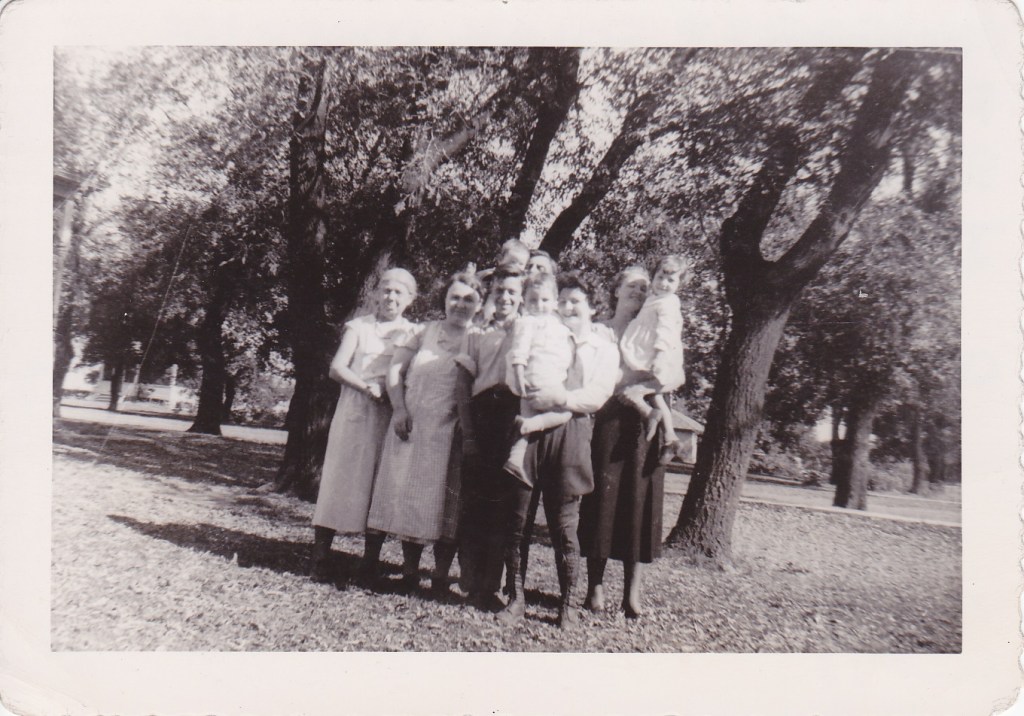
This photo predates the letter by ten years but shows several key characters: Her Nibs is on the left, Mary is next to her, and Agnes is in the middle, in the cute jodhpurs holding her niece. Benson, 1934 (Private Family Collection)

“I know it’s in here somewhere…”

My grandma, looking for something (Photo: Private Family Collection)

There are few pictures of my grandma.* She appears in an occasional group photo, but otherwise, she had a knack for avoiding the lens. I remember her saying that the camera “does me no favors.” That was the closest Grandma came to a statement of vanity.

I love this photo of Grandma because she either does not realize the photo is being taken or she does not care. She is 100% focused on the task of retrieving something from that glass.

I wonder what she was looking for.

I asked Regan (my sister and fellow wonderer) what she thought. Regan came up with several elaborate scenarios, but then said, “I bet she was looking for a pencil to keep score.” Bingo. That was it. Grandpa was shuffling the cards and Grandma scrounged up a scrap of paper (or old envelope or just about anything one could write on) and was looking for a pencil.

Somewhere in that glass was a Mongol yellow pencil. Grandma would have to dig a bit because more than likely the pencil would be squat, at least half-used, the wood hacked away with a paring knife to expose a centimeter’s length of lead at a time. A pencil sharpener was an unnecessary luxury. Grandma always had that pencil, somewhere in her house when I was young. I am sure there were several pencils floating around her house matching the description, but only one ever appeared at a time.

Grandma’s glass was a catch-all, something of a portable junk drawer. At any given time it would have held one of those white sticks for marking fabric, a book of matches, a metal clicky ball-point pen from the bank, and a couple bits of string (too short to be of any real use, but Grandma hated to toss anything). I also imagine a couple of pennies, a hair pin, and a thin layer of dust at the bottom of that glass.

I have my own portable junk drawer sitting on my desk. It is a large cup that includes pens (some even work), a scissors, a letter opener, a ruler, and random bits at the bottom (paper clips, old post-it note, a rusty bolt). From time to time I will find myself hunting for that specific Flair felt-tip marker or gel pen in my cup, digging and pulling up a thirty-year-old empty fountain pen, a crochet hook, or a yellow Mongol pencil.

The pencil tip is soft and dull, and the years have darkened the surrounding uneven wood. I can see Grandma standing over the garbage can with an old paring knife, carving away at the pencil, exposing lead enough for completing a few crossword puzzles or scoring a weekend of card games. I think about other things: Grandma’s boiled dinners, little dishes of ice cream with Spanish peanuts, and endless games of “Spite and Malice” at her kitchen table (just to name a few of thousands of memories). I put the pencil back in my cup, in a much better mood than I was when I pulled it out.

I wonder if my grandma had something in her glass, something that she kept there so that from time to time she would come across it and remember someone special to her…

*Caveat: There are a bunch of adorable snapshots of my grandma in her twenties, hamming it up with friends, family, and coworkers. I will share some of those soon.

Long and Short Blocks

Until I was six years old, my grandma lived on Tenth Avenue in South Minneapolis in a one-and-a-half story stucco house. A hill rose up from the sidewalk, cut in by a steep set of steps, with a path of a few squares of concrete to up to the house. The front door was located at the side of the facade, which left room for an uninterrupted row of windows facing the street.

Inside the house, under the windows, was a long, narrow radiator. Several small ceramic pots of Grandma’s African violets sat on top of the radiator. The flowerpots were painted in muted colors – one lemony yellow, another minty green, and a third was creamy marshmallow white. To catch any excess water drips and drains, Grandma had placed old teacup saucers beneath each flowerpot.

The furry green leaves and soft purple petals of the violets thrived year-round at Grandma’s, with the afternoon sun of summer and the winter warmth provided by the radiator. There was also one larger, fancier pot in the mix, painted dark pink and white and embellished with a sweet, rosy-cheeked lamb figurine.

My grandma’s rocking chair was in the corner of the room, near the front windows. I remember cuddling up on her lap as we rocked and she read me books, told me stories, and sang to me. Her hand resting on the top of my head, periodically smoothing the wispy hair from my forehead to behind my ear.

One of my favorite songs in Grandma’s repertoire was the silly “Mares eat oats, does eat oats, and little lambs eat ivy, a kid will eat ivy, too. Wouldn’t you?” I’d look over to the lamb lounging by her pot of violets and think that sometimes they might eat violets, but I knew that didn’t rhyme and would ruin the song.  “What a comical song,” Grandma would say at the end, with a laugh. Her resonant and jolly laugh seemed to roll slowly out of her belly and through her wide, smiling lips, straight to my ears, gently landing on my memory forever.

Sometimes Grandma and I would walk to Wilharm’s Drugstore up on 38th and Chicago.  I lived about a mile from Grandma, so her neighborhood was less familiar terrain. This walk was an adventure, made even more thrilling if Grandma needed to mail something. Grandma always let me “do the honors.” I remember stepping up on the cement base that held the big blue box on the corner near her house, peering over the edge, grabbing the handle and sliding the mail down the chute. I’d let the door close gently, wait a few seconds, and open it again and investigate the darkness within the chute, just like Grandma taught me. “You want to be sure it all made its way down…” she would say.

After the mail drop, Grandma would take my hand and we’d continue our journey.

“How much farther, Grandma?”

“Well, let’s see. It’s five long blocks and two short blocks.”

That felt like an eternity to me. I wondered aloud to Grandma what we would have done if the mail hadn’t gone down the chute. I thought to myself that we would grab a long stick and shove it into the chute to free the mail, but Grandma said we would let the mailman know. That seemed easier than my plan.

“How much farther now, Grandma?”


“When we cross the street, it will be four long blocks and two short blocks.”

I tried to limit my inquiries to when we crossed a street, but sometimes those long blocks were so long, I’d lose my place and my patience. But Grandma never did. No matter how often I asked, she’d smile down at me and give my hand a squeeze and tell me the status of our journey.  We would chat some more until finally I spotted the traffic lights ahead and I knew we were close. “Almost there,” Grandma would say. I don’t remember what we did when we arrived at Wilharm’s.  Maybe Grandma had to pick up a prescription or a new bottle of mercurochrome (her go-to treatment for all injuries).

Last week, George Floyd stopped into Cup Foods on the corner of 38th and Chicago where Wilharm’s Pharmacy used to be. Floyd was arrested for passing a bad $20 bill. He died after a police officer pinned him to the concrete sidewalk with his knee for more than eight minutes, the final two-and-a-half of which Floyd was unconscious. A week of demonstrations and riots has followed Floyd’s senseless murder. As people grapple with their anger, frustration, and sadness they are finding some peace and comfort at the site of the murder, calling 38th and Chicago, “sacred ground.”

So much of South Minneapolis is sacred ground for me, not because of a tragedy, but because it’s intersections, sidewalks, and structures hold the memories of my childhood and young adulthood. As they covered the protests, every block the TV reporters called out as they stalked the demonstrators sparked a memory of an event or a loved one or a mundane bus ride, from thirty years ago. *  

I hope that the memory of this past week stays with us all and we get our acts together and work for real change. There will be both long and short blocks in the process. Hopefully, 38th and Chicago will remain sacred ground for generations to come.

*Did it drive anybody else crazy that the LOCAL reporters called it Ni-COH-let Mall? It’s pronounced “Nicklet” and it’s only the mall downtown.

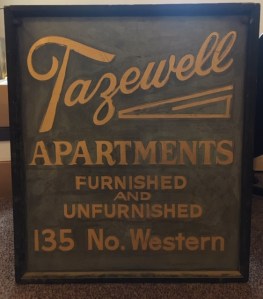
Home at The Tazewell

I have always been fascinated by history. I’d love to be one of those people who truly lives in the moment, but I can’t. Sometimes it is more interesting to wonder about the past than face the present. (I fully understand the danger in this way of thinking…) From the mysterious figures looming in my family tree to stories about the people and buildings of my historic neighborhood, I am curious about what life was like and what motivated people to do what they did. For me, the smaller the story may seem, the more attracted I am to it.

From the moment my realtor showed me the condominium at The Tazewell twenty-two years ago, I knew it was the place for me. The three-story brick building was neat and tidy, the unit we looked at was chock full of sunshine and charm, and it was (almost) in my budget. Sure, there was a hideous wicker-accented ceiling fan in the middle of the dining room and tan wall-to-wall carpeting (very early-1980s), but it also had a built-in buffet and a walk-up dressing room in the bedroom. It was adorable.

I had been in a lot of apartment buildings in the Twin Cities, but I had never seen one exactly like The Tazewell. It wasn’t the grandest I’d seen, but something about it stirred my imagination. I wondered who built it, what the interiors looked like originally, and who called The Tazewell home before me.

Bit by bit I satisfied my curiosities and developed new ones with intermittent research. With the opportunity to write an article for Ramsey County History Magazine presented itself, I got serious about sharing the history of a St. Paul, Minnesota apartment building on the occasion of its 100th anniversary. Like most to reach the ripe age, The Tazewell basked in the glory days of her youth, endured the struggles of decline through middle age, and with equal doses of stubbornness and luck is still here today. Click here to read the article.