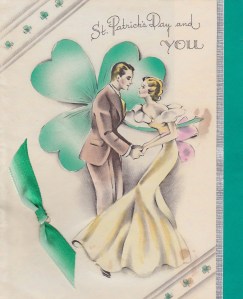
Ah…spring is in the air. The sunshine and rising temperatures have melted a recent 10″ snowfall here in St. Paul, daylight saving time is on, and St. Patrick’s Day is just around the corner. I love this time of the year. I can’t wait to catch a few performances by Rince na Chroi (the Irish dance group my nieces perform with) this weekend and enjoy a pint or two of Guinness to celebrate my Irish American heritage.
When I was a kid in Minneapolis during the 1970s and 1980s, no one I knew made a big deal about St. Patrick’s Day. We were an Irish American family and proud of our roots, but the most we did on the day was walk up to Curran’s Family Restaurant for the corned beef and cabbage dinner. The meal’s highlight for me was a small dish of vanilla ice cream drizzled with a bright green creme de menthe sauce for dessert.

As I think about those times, I can see my Grandma in her spring coat, a shamrock formed from fuzzy, green pipe cleaners pinned to her shoulder. She had a white scarf printed with delicate green shamrocks tucked around her neck under the coat’s collar like older women used to wear. Grandma stood patiently in the packed restaurant, handbag dangling before her, smiling pleasantly as we waited far too long for a table to open up.
I imagine that Grandma wondered why so many people were at Curran’s making such a fuss about St. Patrick’s Day. It was so different from when she was young.
My grandma was not just a wonderful person and grandma; she was my physical link to my family history. As a girl, she spent time with her grandpa, who came from County Fermanagh in the mid-19th century. She shared the stories she remembered from him and stories of her other Irish grandparents. My grandma’s stories fed my curiosity about my family’s origins. Grandma embodied all of that for me.
This time of year, I hear people in Ireland scoffing at the American tradition of corned beef and cabbage on St. Patrick’s Day (“No one EVER eats that in Ireland,” they say). Point taken, but meat, cabbage, potatoes, and carrots are certainly consumed in Ireland today as they were one hundred years ago and more when most of the ancestors of the nearly 32 million Americans who claim Irish ancestry came to America. That was a time when corned beef was widely available and affordable. As immigrants established themselves in their new homes, new food sources became available, and corned beef seemed to be phased out.*
I consider my grandma’s boiled dinner the quintessential Irish American meal. How her house smelled while it was cooking, how she served it up with the same spoon her mother used, and the cursory, “You’ll have another potato,” as a statement rather than a question made it feel like generations of family memories simmered in that pot. This is the food they ate on the farms in Clontarf, Minnesota. Cooking was another way Grandma told family stories.
Grandma’s humble boiled dinner will not replace today’s delicious St. Patrick’s Day fare, but it remains an expression of my family’s history. Compared to my St. Patrick’s Day experiences (and Grandma’s before me), the day has become an overly-hyped commercial event. That said, seeing how excited my nieces get for St. Patrick’s Day is fun. They perform all over the Twin Cities, march in the parade, hang out with their friends, and generally have a ball. Times change. Whether you celebrate your heritage, the contributions of the tens of millions of Irish Americans, or just like to have fun, St. Patrick’s is the day for you.
Grandma’s Boiled Dinner Recipe
Put enough meat (seasoned with salt and pepper), potatoes, carrots, cabbage, and onions to feed however many people you have for dinner in a pan with water, boil, and simmer until the meat is tender and the vegetables are done.
Grandma used country-style pork ribs (I only know this from shopping with her). I regret that I never noticed how Grandma put together the boiled dinner. It was usually ready when I got there for dinner, and it was always delicious. Mine has never tasted as good as Grandma’s, but I’ll work on it.
*I didn’t get into the whole story here, so if you are interested in the history of corned beef in Ireland, read this article. It is fascinating.

 Aine C. McCormack